
© 2026 Monument Traders Alliance, LLC

Be honest… this has happened to you, and I’ll never forget the first time it happened to me.
I was working for Prudential Securities as a Series 7 licensed stockbroker. It was my first job in the business, and I was still in college. This was my chance to put those finance and accounting classes to work.
The stock was Motorola (MOT back then).
Earnings were two weeks away, and I was determined to nail the analysis, impress my short list of clients, and, more importantly, my mentor, Andy.
I did the work. Just short of wearing the green accounting visor, I crunched the numbers, printed my findings (on the HP DeskJet) for everyone to admire, then called my clients to start taking positions.
This was going to be my first home run.
On earnings day the results came over the squawk box after the close. Yes, we actually had those on our desks.
Motorola beat earnings estimates by 8%!
Fists pumping. Victory laps around the office. I’d nailed it.
Then came the next morning.
Motorola dropped 12%…
My victory lap turned into a lesson in humility, accompanied by a telephone that seemed to ring angrily every five minutes.
The stock recovered a little more than a week later, but the damage was done. I’d learned something that no accounting class had taught me.
Being right about earnings doesn’t mean you’re right about the trade.
One of my favorite investing books, The Art of Contrary Thinking, by Humphrey Neill, contains this quote:
“I find more and more that it is well to be on the side of the minority, since it is always the more intelligent.”
That’s the heart of my contrarian approach, and it explains what happened to Motorola.
When everyone expects a company to beat earnings, investors buy ahead of the announcement. That optimism gets built into the stock’s price.
We call this “Priced for Perfection.”
The company can beat estimates, sometimes by a wide margin, and still see its shares collapse because investors were expecting even more.
It’s the classic “buy the rumor, sell the news” trade.
The opposite is equally powerful.
When everyone expects a company to miss earnings, investors have often already sold the stock or positioned themselves with puts.
Then the company reports inline numbers and the stock shoots through the roof.
Short sellers cover. Put buyers scramble. Investors sitting on the sidelines start buying.
On widely held stocks, that relief rally can quickly become a FOMO rally.
The earnings weren’t great. The expectations were worse.
Look at NVIDIA (NVDA).
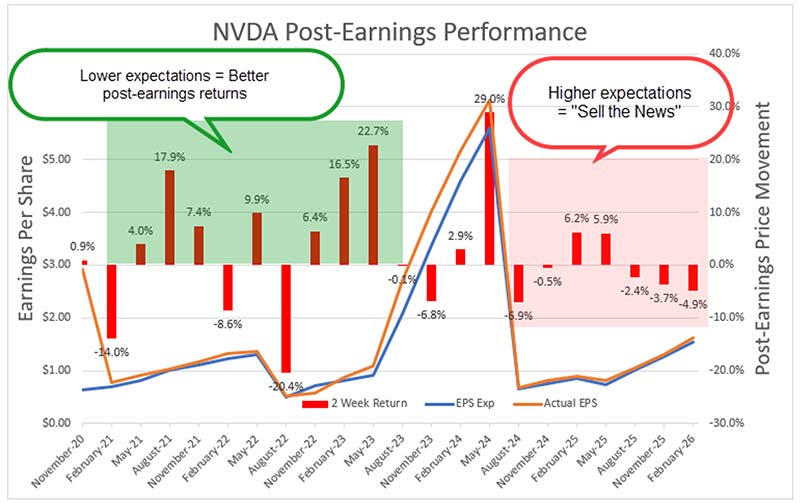
During the early stages of its AI-driven bull market, NVIDIA routinely rewarded investors with rallies following strong earnings reports.
Expectations were bullish, but there was still skepticism. That meant that NVIDIA could still impress with their results. And they did.
But as the AI trade became Wall Street’s favorite investment, that changed.
From 2021 through 2023, NVIDIA had five two-week rallies of 15% or more following earnings. Since then, none. The stock’s actually averaged -0.9% returns over the two weeks following earnings.
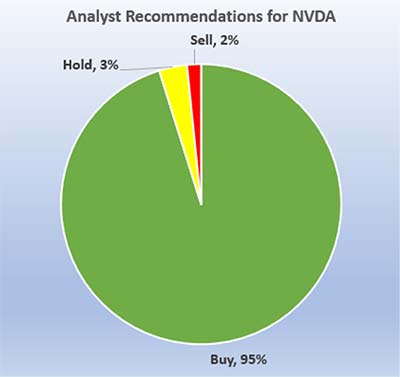
During the early stages of NVIDIA’s bull run, roughly 72% of Wall Street analysts rated the stock a “Buy” or “Strong Buy.” That number has since climbed to 95%.
 |
At the same time, options traders have increasingly loaded up on calls ahead of earnings.
That’s a dramatic shift in investor sentiment, and it tells me one thing: NVIDIA is always priced for perfection.
When virtually everyone on Wall Street is already bullish, even blockbuster earnings may not be enough to drive the stock higher. There’s simply too much good news already priced into the shares.
Great company. Great earnings. Bad short-term trade.
Here’s what I look for ahead of earnings.
I also watch the financial media.
“This company is struggling heading into earnings.”
“They simply can’t afford to miss.”
“The smart money is moving to the sidelines.”
Those headlines tell me something about expectations, especially when they contradict a stock’s strong fundamentals and bullish technical trend.
But here’s where my approach differs from simply betting against the crowd.
I don’t need to predict the earnings report to make the trade.
There are roughly 252 trading days in a year and only four quarterly earnings announcements.
Why let four days dictate your entire trading strategy?
The Motorola experience taught me that the market’s immediate reaction to earnings is often more emotional than analytical.
When a fundamentally strong company reports great earnings but sells off because it was priced for perfection, I’m watching the technicals.
Does the stock hold its 50-day moving average? Does selling volume begin to fade? Is there support near the 200-day? Are buyers stepping back in?
Those are the signals that matter.
I’m not blindly buying the first big red candle after earnings. I’m waiting for the selling pressure to exhaust itself and the technical trend to confirm that buyers are returning.
That’s where a temporary earnings-driven reset can become an opportunity.
The same applies in reverse. A weak company can rally on a relief trade, but that doesn’t necessarily change its longer-term bearish trend.
The earnings report creates the volatility. The technicals tell me when to trade it.
Motorola recovered within days of that painful lesson in 1991. I wish I’d understood then what I understand now.
That’s the contrarian opportunity I’m looking for this earnings season.
Let the crowd trade the expectations. I’ll trade the overreaction.
P.S. Notice when Motorola’s numbers hit the squawk box: after the close. By the time I could do anything about it, the damage was done.
That stretch between the closing bell and the next morning’s open is where Bryan Bottarelli does his best work, and he thinks it’s about to get a lot busier. He sees six forces, including the midterms, rising rates, U.S. debt, and this morning’s hotter-than-expected inflation, converging to set up 90 days of peak volatility.
Bryan’s built a strategy to flip that chaos into some insane potential overnight gains.
He’s laying out the whole plan tomorrow, Thursday, October 15, at 2 p.m. ET. It’s free to attend, just click here to save your seat.
