
© 2026 Monument Traders Alliance, LLC

Something strange is happening in the Treasury market.
For months, the Fed has been trying to navigate toward lower rates under new chairman Kevin Warsh, while the White House pushes hard for the same thing.
The Administration wants lower interest rates and it wants them now.
And for good reason… lower rates make big-ticket purchases more affordable and free up corporate capital for jobs and growth.
And then there is the biggest borrower of them all.
The national debt crossed $40 trillion this week, and interest expense now trails only Social Security among Washington’s biggest line items, ahead of Medicare, Medicaid, and defense.
Every basis point matters when you’re financing $40 trillion.
But the Fed can’t just wave a wand (or fire a Fed Chairman) and lower rates.
Inflation’s decline has stalled. CPI and PPI are reflecting renewed pressure, with higher energy prices tied to the war with Iran bleeding into everything from groceries to shipping .
Oil prices don’t stay in the oil market.
That’s tied the Fed’s hands. Last month’s FOMC meeting even included serious talk of rates moving higher.
So, if the Fed can’t lower rates, who can?
While Washington debates policy, the bond market has been deciding for them, buying fewer bonds and pushing rates higher.
Treasury demand has weakened across the curve, and China and Japan, two of the largest buyers of U.S. Debt, have all but stopped their purchases.
Remember the basic mechanics.
Bond prices down = yields up.
Meanwhile, hyperscalers are issuing enormous amounts of debt to fund the AI data center buildout, competing with record Treasury issuance for the same pool of fixed-income capital.
More supply, fewer buyers.
That’s a recipe for higher rates.
And that’s exactly what we’ve been getting.
For the second time in two weeks, Bessent has thrown the markets a curveball.
First came the announcement that the U.S. would buy massive amounts of yen to support the Japanese currency, knocking the dollar from its bullish trend and sparking another move higher in gold.
Then came Wednesday.
Bessent announced plans to double liquidity-support buyback operations in longer-dated Treasury debt, increasing individual operation caps from $2 billion to at least $4 billion through November 4.
Treasury is effectively stepping into the 10-to-30-year market as an additional buyer.
More demand = higher bond prices = lower yields.
And that’s exactly what happened on Wednesday. Long-duration Treasuries jumped and yields dropped.
Mission accomplished?
Not so fast.
You can’t fight City Hall, and you can’t fight the market… it always wins.
Here’s why.
 |
Washington already has a $40 trillion debt problem.
Now Treasury wants to commit even more resources to support the bond market while deficits keep growing.
Call it liquidity support, debt management, or whatever terminology Washington prefers.
The market sees the bigger picture.
More debt. More government intervention. More pressure to keep financing costs artificially low.
That’s not a bullish cocktail for the dollar.
And a weaker dollar opens another door.
Put on your tinfoil hat, because here’s where things get interesting.
Take another look at Bessent’s timetable.
The expanded Treasury buying runs through November 4.
Know what’s November 3?
The U.S. midterm elections. Coincidence? I think not!
Now, there is a legitimate technical explanation. November marks the beginning of Treasury’s next quarterly refunding cycle.
But you can’t view this in a vacuum.
The Administration has spent the last two years publicly demanding lower rates, pressuring former Fed Chairman Jerome Powell and other officials.
But the pushback was fierce.
The Fed serves its dual mandate.
It doesn’t serve the Administration.
And those attempts largely failed.
Here’s the interesting difference.
That makes this Treasury operation look suspiciously like an end-around pass.
Can’t convince the independent Fed to aggressively lower rates?
Fine. Have Treasury create additional demand itself.
And just happen to run it through the day after the midterms.
I’m not saying that’s proof.
I’m saying you’d have to work pretty hard not to notice the coincidence.
The good news is we don’t need to solve the conspiracy theory to trade it.
We just need to follow the money.
Hedge the bond trade.
The first opportunity is defensive.
Remember that “The Market” is bigger than Scott Bessent.
The 30-year Treasury has already given back roughly half of Wednesday’s initial move. That matters… Treasury can influence the market, but it can’t dictate it.
I told viewers during this week’s Monday Morning Minutes that the iShares 20+ Year Treasury Bond ETF (TLT) may be the most important chart in the market right now.
Despite Wednesday’s Bessent-induced spike, TLT’s primary trend remains bearish and threatens another move toward its lowest levels since the 2023 recession.
One way I hedge that risk is through the ProShares UltraShort 20+ Year Treasury ETF (TBT).
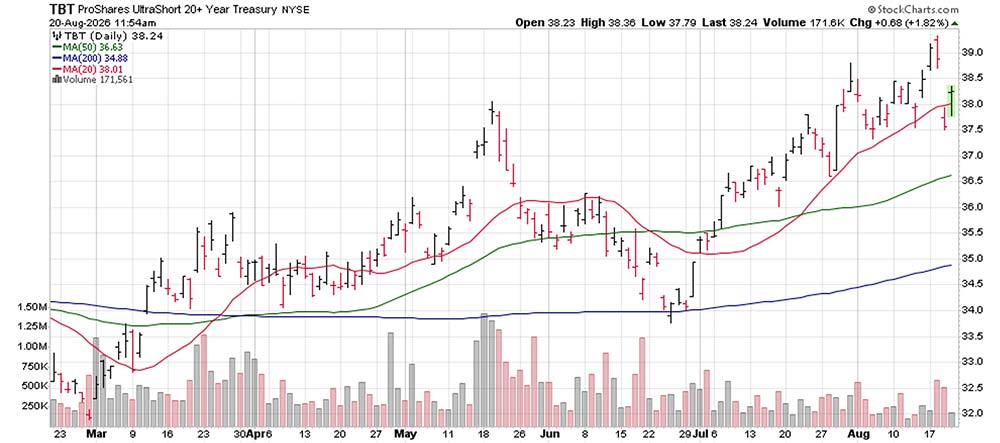
TBT is a leveraged inverse Treasury ETF designed to move approximately 2% higher for every 1% daily decline in its underlying Treasury index.
For my portfolio, slightly out-of-the-money, long-dated TBT calls provide a simple way to offset the risk of another leg lower in long-duration bonds.
Then there’s gold. And this may be the bigger opportunity.
Rising government debt, stubbornly high rates, Treasury intervention and a weakening dollar create exactly the environment that can send investors running back toward gold.
That’s the recipe for another run toward $5,000 and beyond.
I’m watching the SPDR Gold Shares ETF (GLD) closely.
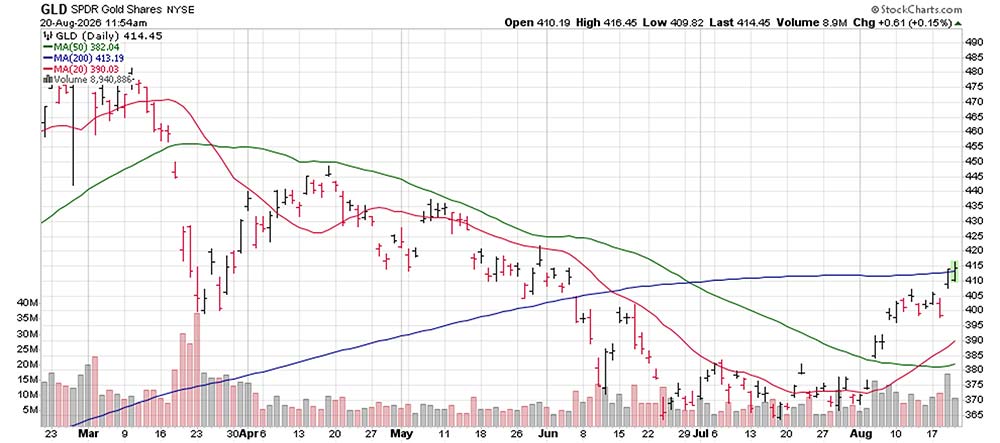
It’s moving back above its 200-day moving average for the first time since June.
That’s significant.
A sustained move above the 200-day would tell us that gold’s long-term technical trend has shifted back into the bulls’ hands.
My preferred strategy is straightforward: long-dated GLD call options designed to participate in the next sustained leg higher.
Scott Bessent may be trying to manufacture lower interest rates.
The bond market may ultimately tell him no.
Either way, investors don’t have to get caught in the fugazi.
Follow the trend, hedge the risk, and let Washington provide the catalyst.
