
© 2026 Monument Traders Alliance, LLC

There I was, sitting in a hospital at 10 p.m. waiting for a doctor to put a few stitches in my son’s chin.
He’d taken a hockey puck to the chin about an hour earlier while playing in my adult league game.
I was waiting for THE CALL from my wife. You know, the one where she says she’d been waiting for our son to get hurt playing with a bunch of older guys in a beer league.
Instead, my phone buzzed with a number from Boston.
I’d been waiting on this call all afternoon, after leaving several messages with the portfolio manager of one of Fidelity’s larger bond funds.
I couldn’t believe he was calling this late. I jumped out of my chair to find some privacy.
All pleasantries were skipped. He got straight to the point.
“You’re right. It’s redemption risk…”
Bingo. That was the answer I’d been looking for.
The bond market had dropped sharply as rates moved higher, but some bond funds were falling much faster than the bonds they were supposed to represent.
I knew the explanation, but I needed the source to tell me how much worse it could get. The news wasn’t great.
Redemption risk is what a fund faces when lots of investors try to pull their money at once.
Those withdrawals can force the manager to sell bonds to raise cash, often at unfavorable prices, since many bonds are relatively illiquid, especially in stressed markets. That can mean volatility and larger-than-normal drops in the fund’s value.
Redemption risk can cause a bond fund to disconnect from what’s actually happening in the broader bond market.
That was exactly what I saw in the days before that late-night call.
The bond market had dropped roughly 5% in a short period, while clients watched some bond funds fall closer to 10%. That’s unnerving when you think of bonds as “safe.”
The difference wasn’t all about the bonds. It was investors heading for the exits.
And with bonds under pressure again today, that distinction matters more than ever.
Bond prices and yields move in opposite directions. Higher rates = lower prices, and vice versa.
The recent surge in Treasury yields has hammered anyone who already owned bonds or bond funds. But there’s another side to that equation.
The higher yields go, the more attractive bonds become to someone buying them today.
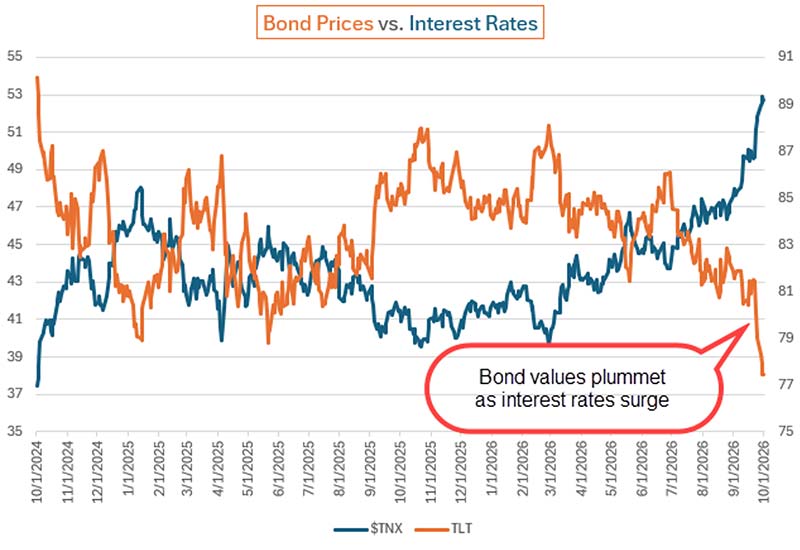
With the 10-year Treasury yield hovering around 5.3%, investors can lock in rates we haven’t seen in nearly two decades.
That raises a question for anyone using bond funds as the “safe” part of a balanced portfolio:
Why not own the bonds yourself?
In an aggressively rising rate environment like this one, owning a fund means you don’t control when other investors sell or when the manager is forced to raise cash.
Own the bond, and you do.
Say you buy a U.S. Treasury yielding around 5.3% today. You collect its scheduled interest payments, and if you hold it to maturity, the government repays its face value.
Rates could rise after you buy, pushing its market value lower. But if you hold it to maturity, you don’t have to sell and realize that loss.
No portfolio manager is forced to sell your Treasury because other investors want out. You control the redemption risk.
Better yet, if and when rates come down, bonds bought at today’s higher yields will rise in value.
If you own a Treasury yielding around 5.3% and comparable new Treasuries eventually yield 4%, your higher-yielding bond becomes more attractive, so its price rises.
That gives you two potential sources of return: income from the higher rates you locked in and potential price appreciation if rates decline.
Then it’s your call: sell and potentially realize that gain, or keep holding it and collecting the income.
Individual bonds aren’t risk-free. Selling before maturity can result in a loss, inflation can reduce purchasing power, and corporate and municipal bonds introduce additional credit risks.
But today’s yields have changed the calculation.
As with stocks, you don’t have to put everything into one 10-year bond.
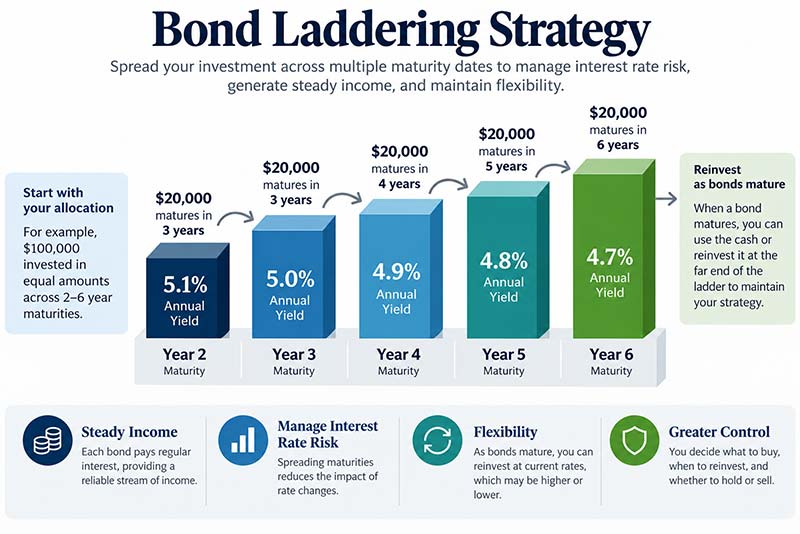
A simple bond ladder spreads your money across several maturity dates.
An investor with $100,000 allocated to bonds could put $20,000 each into bonds maturing in two, three, four, five, and six years.
As each bond matures, use the cash or reinvest it at the far end of the ladder.
If rates keep climbing, you can reinvest at higher yields. If they fall, you’ve locked in today’s rates on the longer rungs, and those bonds may appreciate.
Bond funds aren’t going away. Their diversification, professional management, and convenience still make sense for many investors.
But for most of the past 20 years, rates were so low there wasn’t much incentive for the average investor to build an individual bond portfolio.
Today there is.
Redemption risk is one more reason to own bonds directly: When you own the bond, you decide whether to sell.
For balanced investors, that mix of income, potential appreciation, and control makes this one of the few times in 20 years when building your own bond portfolio may make sense.
