
© 2026 Monument Traders Alliance, LLC

At 4:00 p.m. Eastern today, the countdown ends. NVIDIA (NVDA) reports earnings, and the setup around this one is more treacherous than anything we’ve seen in three years.
That doesn’t make NVIDIA a bad company. It makes it a stock about to be judged by a tougher standard.
NVIDIA is still the granddaddy of the AI trade, its chips still the industry standard.
But it’s no longer the unquestioned leader it was three years ago, with competition rising, growth leveling off, and investors expecting near perfection every time it reports.
That combination makes tonight’s number especially important, with September’s seasonal volatility just days away.
Here’s the setup.
Start with the Chartprice tells you exactly what investors are doing with their money.
NVIDIA shares have drifted lower into Wednesday’s report, testing their 50-day moving average just below $210, a trendline that’s flattened as the intermediate-term trend slips from bullish to neutral.
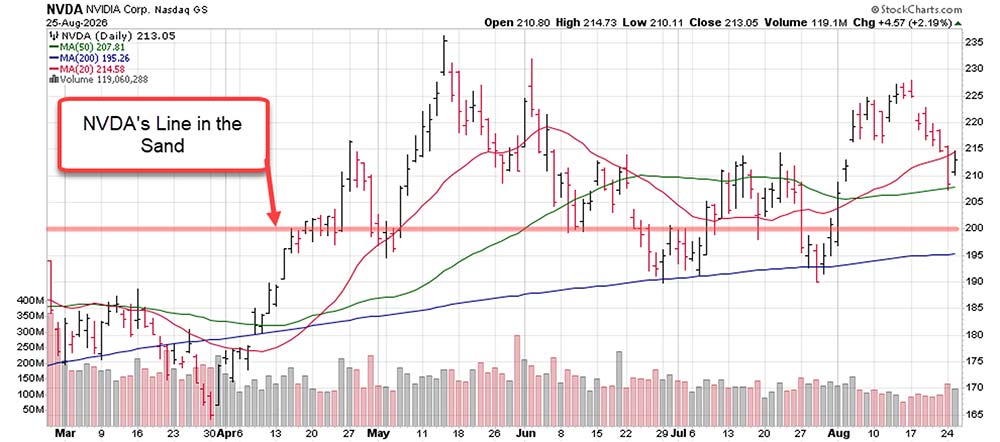
The bigger warning: NVIDIA already tested $200 and its 200-day moving average this month. Sellers are already showing up before earnings, raising the stakes for Wednesday’s reaction.
Round numbers like $200 work as psychological triggers, for humans and algorithms alike. A break below it after earnings would likely accelerate selling and confirm the trend has turned.
That’s when volatility should accelerate.
Fundamentally, NVIDIA is still one of the strongest companies in the market. But Wall Street doesn’t pay for great numbers, it pays for numbers that beat expectations and keep accelerating.
That’s getting harder.
Last quarter’s earnings growth came in at 15.4%, below its five-year average near 22%. Revenue grew 85% year-over-year, just above its 82% average.
Phenomenal for almost any company… but NVIDIA isn’t just any company.
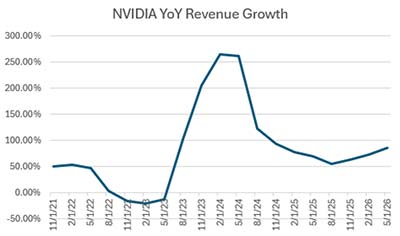 |
Two years ago, revenue growth ran north of 250%. Investors trade the direction of growth, not its size, and that direction has fallen for two straight years.
Competition is also increasing.
AMD and the hyperscalers keep building AI chips, chipping away at NVIDIA’s stronghold as computing becomes more commoditized.
There’s a longer-term threat too: quantum computing.
Google, IBM and IONQ keep pushing quantum technology forward. It doesn’t need to replace NVIDIA’s GPUs, just pull enough speculative capital and attention away from AI.
For years, NVIDIA has been the story.
Eventually, investors start looking for the next one.
 |
This is where Wednesday’s setup turns dangerous.
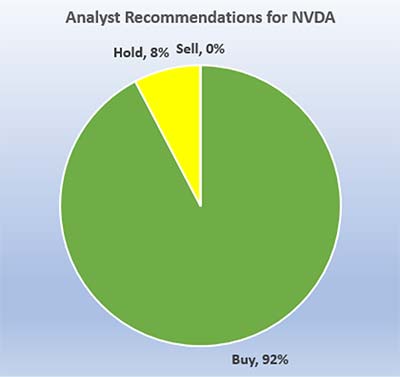
Put yourself in the room: 49 analysts cover NVIDIA, 45 already say buy, nearly everyone else sits at Hold. Nobody is telling clients to sell.
That’s the problem with expectations this lopsided. Another blowout quarter can send shares higher, but a miss, cautious guidance, or even a fine outlook that doesn’t clear the bar could trigger downgrades and selling.
Options traders lean the same way. Call volume and open interest have outweighed puts for two straight weeks, positioning for another beat-and-raise.
If they don’t get it, that positioning becomes fuel for the sell-off.
NVIDIA doesn’t need bad earnings to fall. It needs earnings that aren’t good enough.
Even a 97% revenue jump might not satisfy the greedy pigs on Wall Street.
The stock’s recent post-earnings track record backs that up.
Over the last five years, NVIDIA has traded higher just 43% of the time in the two weeks after reporting. Lately, that number has gotten worse.
The last four quarters tell the real story: every one closed lower two weeks out, for an average loss near 3.7%. Whatever NVIDIA reports, the room has already decided how to react.
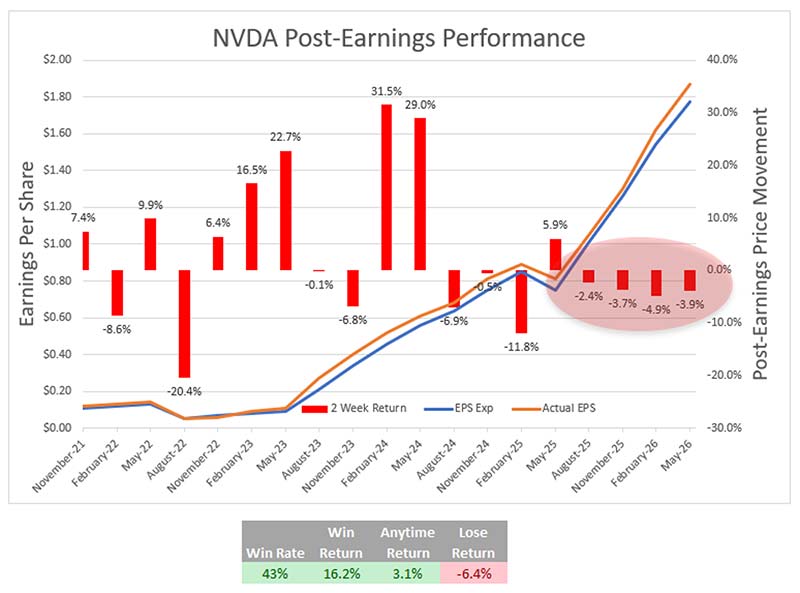
That’s not disappointment with the business. It’s disappointment with results that don’t clear expectations already priced into the stock.
And those expectations remain sky-high heading into Wednesday.
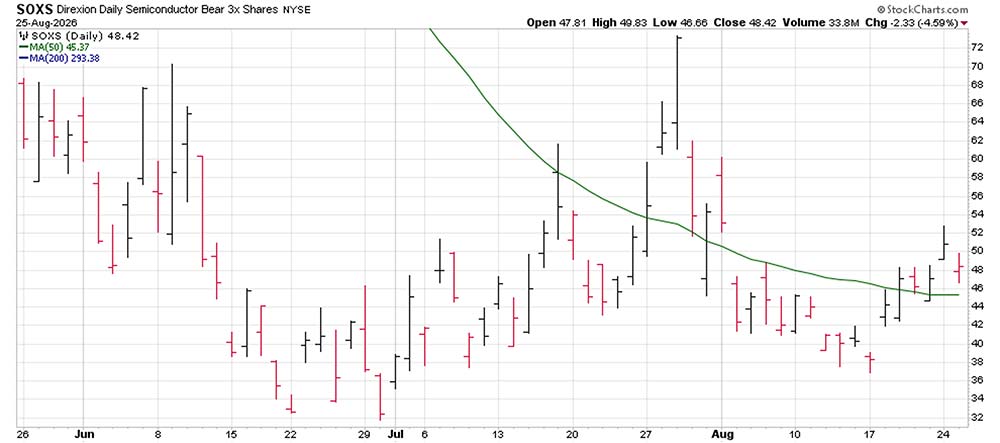
Full disclosure: I’m still holding a hedge against the semiconductor sector, using December call options on the Direxion Daily Semiconductor Bear 3X Shares (SOXS). That reflects my broader view that semiconductor and memory stocks weaken into a seasonally volatile September.
For NVIDIA specifically, I’d rather not guess Wednesday’s direction.
I’m looking at a strangle using September expiration $200 puts and $220 calls.
Buying both sides costs more upfront, but the goal isn’t predicting a beat or miss, it’s capturing the volatility surge that follows.
This position is a bet that NVIDIA moves 5% or more, in either direction.
Traders can close both legs after earnings to capture that move, or close the losing side once a new trend emerges and let the winner ride.
That gets especially interesting below $200. A decisive break combined with a breach of technical support could kick off a new bearish trend just as September’s volatility ramps up.
That brings us back to the number I’ll be watching Wednesday night.
NVIDIA is still one of the greatest companies in the market, but great companies don’t always make great trades.
Right now, it’s carrying weak technical momentum, slowing growth, rising competition, and sky-high expectations on Wall Street.
That’s a disproportionate risk-to-reward setup.
If NVIDIA delivers another spectacular quarter, the bulls get another run. But anything less than Wall Street expects, and a break below $200 could turn Wednesday’s report into the starting gun for September’s volatility.
P.S. My NVDA strangle is built around one moment: the volatility spike right after tonight’s number hits the screen.
Bryan Bottarelli trades on a different clock entirely. His Stock Flipping System runs off a simple afternoon buy, then a flip the very next day. One quick trade, then you’re done.
Year to date, he’s run 19 of these flips, and 17 have closed as winners, an 89% win rate, using nothing but his exact list of the 30 best Stock Flip opportunities he tracks.
A handful of those flips have closed out at gains of 288%, 384%, and 667%.
If watching $200 tonight has you thinking about how fast a stock can move once the market makes up its mind, this system is built for you.
He’s going LIVE tomorrow with the full breakdown. Save your spot here.
