
© 2026 Monument Traders Alliance, LLC

So far, August isn’t following the script.
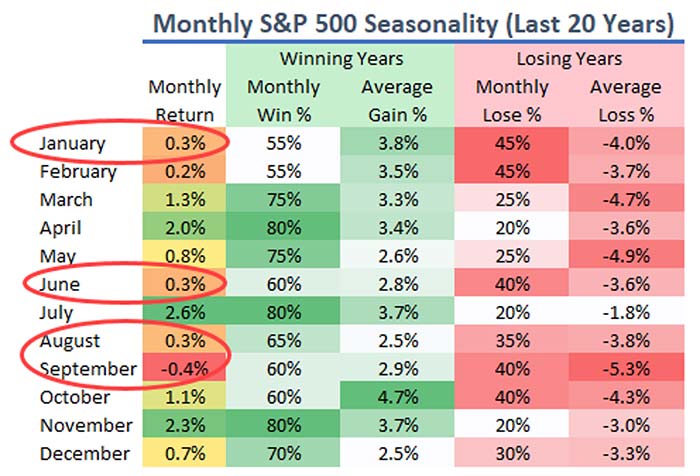
The month entered with the media hyping its historical reputation as one of the market’s weaker periods. And that’s true…
Over the last 20 years, the S&P 500 has averaged a gain of only about 0.3% during August.
September is worse, averaging roughly a 1% decline and ranking as the weakest month of the year.
Lower returns. Higher volatility. That’s the seasonal setup investors have been conditioned to expect… except that’s not what we’re seeing.
Stocks came into August near their highs and quickly moved higher as investors hoped for a conclusion to the war with Iran.
This put the S&P 500 well ahead of its normal August pace as the index now sits 3.5% higher.
|
So, has seasonality stopped working?
Wrong question.
The better question is will August’s strong start give way to the seasonal weakness everyone expected, or will stocks slingshot higher instead?
There’s nothing mechanical about sentiment. Short interest, by comparison, is mechanical.
When a heavily shorted stock rallies, short sellers get squeezed into buying, which pushes prices even higher
Seasonality doesn’t work that way. Seasonality is driven largely by expectations, psychology, and behavior.
Think herd mentality, group think, and FOMO.
Markets constantly react to expectations. Investors buy when they expect prices to rise and become defensive when they expect prices to fall.
Seasonality helps establish those expectations.
Like the Farmer’s Almanac, market seasonality looks backward at historical patterns to establish what is likely to happen next. It isn’t a guarantee. It’s a historical tendency.
Once enough investors know about a seasonal tendency, that tendency can begin affecting their behavior.
That’s exactly what happens in August and September.
The cycle looks something like this:
Instead of weakness, we’ve seen strength, but expectations haven’t changed.
Historically, strong starts to August have only delayed the seasonal risk, not erased it.
Don’t assume the pressure disappeared just because stocks didn’t fall on August 1.
It may simply be building.
This is where technical analysis enhances the calendar and seasonality.
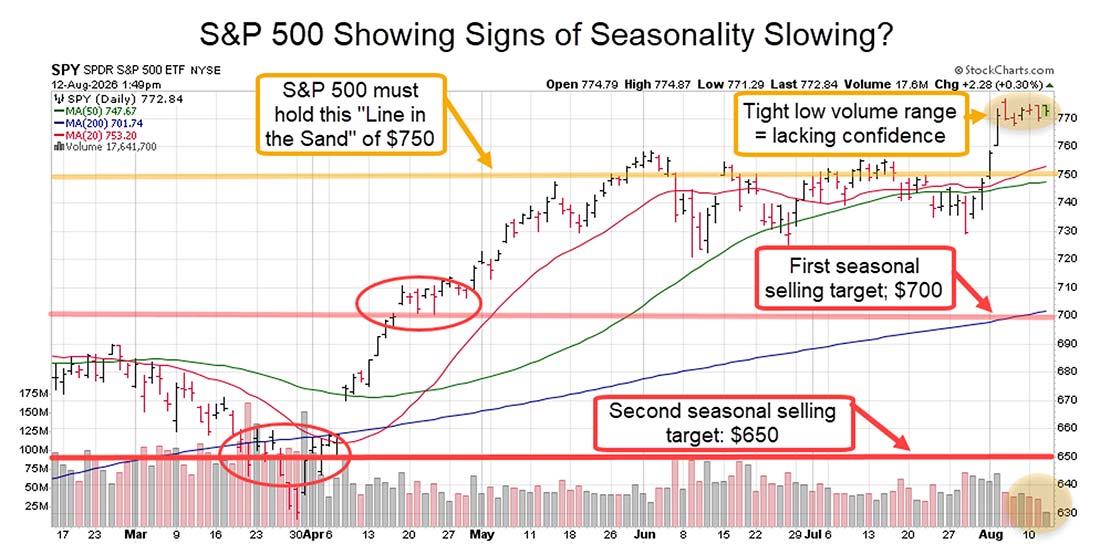
Notice how the SPDR S&P 500 ETF (SPY) is sitting near its highs after spending several sessions consolidating in a tight range.
|
That’s important.
Investors aren’t aggressively selling stocks, but they’re also showing some hesitation about chasing prices higher.
Why?
Because in the back of their minds everyone knows August and September are supposed to be difficult.
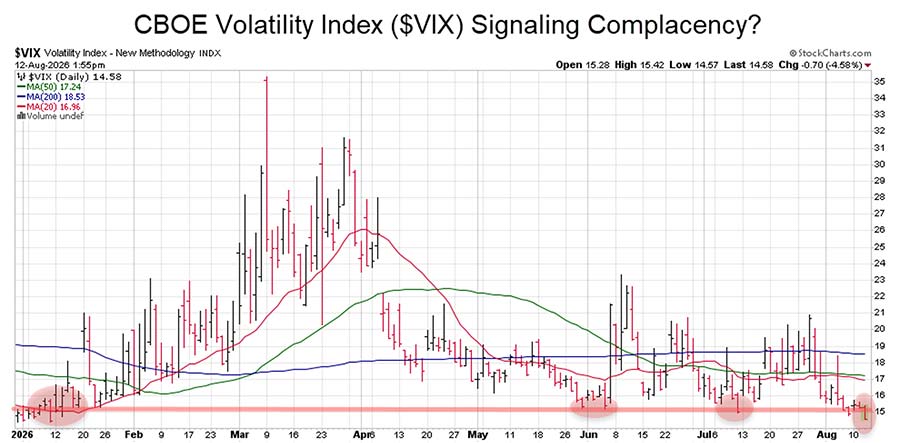
Meanwhile, the CBOE Volatility Index ($VIX) has fallen below 15.
|
That’s a sign of extremely low fear and complacency.
Brace yourself. The last time the VIX was this low was January 2026, right before stocks hit a 10%+ correction that turned into a great buying opportunity
Put those two together and you have a market sitting near its highs while investors are becoming increasingly comfortable.
That doesn’t guarantee a decline now, but as Mark Twain said “history doesn’t repeat itself, but it often rhymes”, and right now the market is singing in chorus with January’s setup.
My line in the sand is SPY $750.
A decisive break below $750 would tell me that short-term momentum has shifted and is likely to trigger the psychological cycle we’ve been discussing.
From there, $700 becomes my first downside target, with the potential for $650 during September if the seasonal decline gains momentum.
Those aren’t predictions. They’re levels that allow us to build a game plan before emotions take control.
This brings me to the most important point.
I’m not telling you to sell everything because August and September are historically weak. I’m telling you to prepare to take advantage of that weakness if it develops.
That starts with a hedge.
Bryan Bottarelli and I are already practicing what I preach… we’re carrying similar hedges on the Nasdaq 100 to protect against near-term weakness and build buying power if that weakness turns into opportunity.
The key is remembering that placing the hedge is only Step One.
Step Two is knowing when to close it.
Every hedge should have a target. A hedge left open indefinitely will eventually fail in a long-term bull market. I’ve identified the SPY $700 and $650 as my current downside targets.
DO NOT try to identify the exact bottom.
Close the hedge near your predetermined target and recognize what you’ve accomplished: you’ve created buying power during a market decline.
Then move to Step Three.
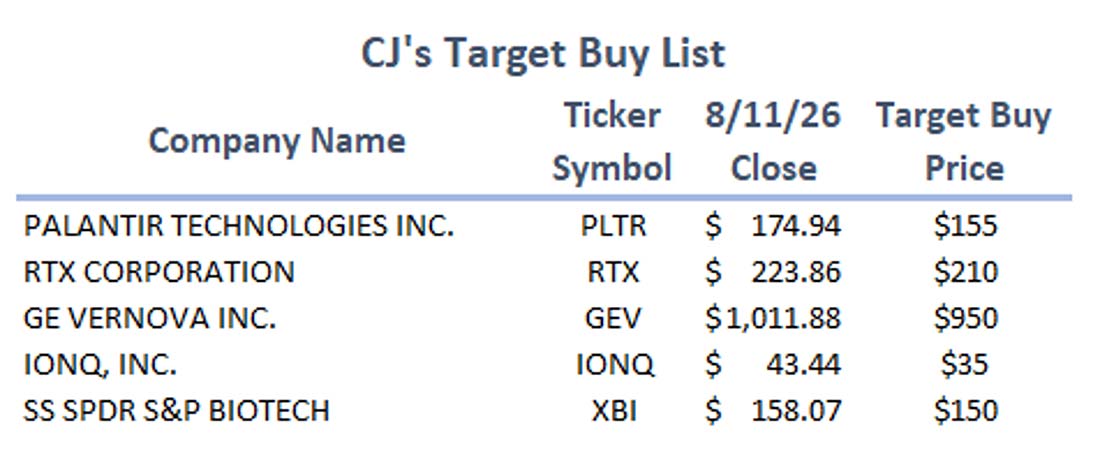
Plan on what you’re going to add to your portfolio if/when stocks are trading lower and, more importantly, the prices at which you want to own them.
Here’s a look at a few of the companies on my list. Always have one of these ready when the market turns against the trend.
|
Most traders only see red during a healthy correction, making it hard to spot opportunity unless you identified it ahead of time.
If seasonal psychology drives stocks lower through August and September, you don’t want to be making emotional decisions while everyone else is selling. You want to already know what you’re buying, where you’re buying it, and where the money comes from.
The bottom line here… Seasonality is driven by expectations and psychology. Your edge comes from recognizing that psychology before everyone else starts reacting to it.
