
© 2026 Monument Traders Alliance, LLC

25 years ago, the idea of letting a robot help perform surgery sounded like something out of a science-fiction movie.
Today, it’s becoming routine.
Intuitive Surgical (ISRG) has more than 11,000 da Vinci systems installed around the world.
Stryker (SYK) has built a major orthopedic robotics business around its Mako platform.
Medtronic (MDT) and Johnson & Johnson (JNJ) are investing heavily in their own surgical robots.
But I think we’re about to enter a much more interesting phase.
We’re giving the robots a brain.
Artificial intelligence is beginning to converge with robotics, medical imaging, diagnostics, genetics, and other healthcare technologies.
Eventually, a surgical robot won’t simply mimic a surgeon’s movements. AI could help it recognize anatomy, identify potential complications, analyze what’s happening in real time, and compare a procedure with millions of previous surgeries.
That doesn’t mean your surgeon is getting replaced next year. I still want a human being in the room, thank you very much (preferably a doctor if it’s not too much to ask).
But it could make every surgeon better.
And the opportunity extends far beyond the operating room. AI is already analyzing pathology slides and medical images. Algorithms can search enormous genetic databases. Semiconductor technology is shrinking medical equipment that once filled half a room into devices that can fit in your hand.
I’ve been investing at the intersection of technology and healthcare for a long time. And one of my biggest winners provides a great example of what can happen when these worlds collide.
Back in February 2015, I recommended a little-known company called Heska (HSKA) at $21.14 live on Fox Business.
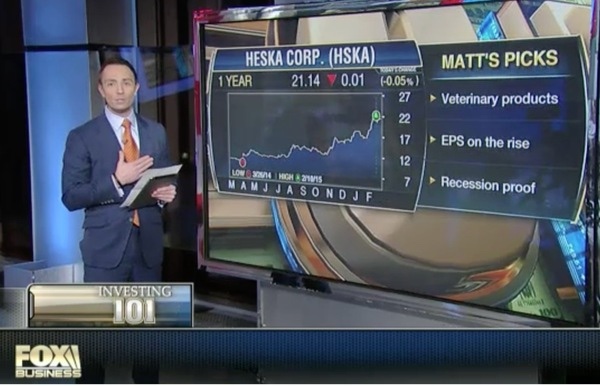 |
Heska wasn’t developing the next blockbuster cancer drug. It wasn’t trying to cure Alzheimer’s. In fact, its patients usually had four legs.
The tiny $135 million company developed diagnostic equipment and technology for veterinary clinics. What interested me was how technology was changing what veterinarians could do inside their offices. Better diagnostics, imaging, software, and point-of-care testing meant faster answers and better treatment.
Heska was a healthcare company.
But increasingly, it was also becoming a technology company.
That’s a combination I’ve always loved.
The stock eventually climbed above $275, handing us a peak gain of more than 1,200% from my original recommendation. Mars ultimately acquired Heska in 2023 for $120 per share.
The lesson from Heska is bigger than veterinary medicine. Some of the best healthcare investments I’ve found aren’t necessarily companies discovering drugs. They’re companies using technology to make medicine faster, cheaper, more accurate, or more accessible.
Which brings me to a small company I’m watching today.
Butterfly Network (BFLY) has developed something called Ultrasound-on-Chip.
Traditional ultrasound machines can be large and expensive. Butterfly uses semiconductor technology to put much of that capability into a handheld probe that connects to a smartphone or tablet.
That’s pretty cool by itself.
But I’m becoming more interested in what Butterfly is building around that technology.
The company is opening its platform to outside developers through Butterfly Garden and its Embedded business. The goal is to allow other companies to incorporate Butterfly’s ultrasound technology into new AI, robotic, imaging, and medical devices.
One fascinating example is Midjourney Medical, which is developing an automated full-body ultrasound scanner. Its current prototype uses 40 Butterfly ultrasound modules working together.
Think about where that could eventually go. Instead of relying entirely on a highly trained technician to manually move an ultrasound probe around your body, robotic systems combined with AI could potentially capture, interpret, and analyze images automatically.
That’s where AI, robotics, semiconductors, and healthcare all start colliding.
And importantly, Butterfly’s business is beginning to show progress. Second-quarter revenue increased 39% to a record $32.6 million, gross margin reached 71%, and management raised its full-year outlook. The company also now has 11 partners developing products around its Embedded technology.
Butterfly still has plenty to prove, and I consider it a speculative stock. I’m certainly not ready to call it the next Heska.
But it checks a lot of boxes I like.
It’s relatively small, with a $2.3 billion valuation. Revenue is growing. It owns differentiated technology. And it’s positioned directly at the intersection of several enormous investment trends.
That’s a very interesting neighborhood.
I found Heska in a similar neighborhood more than a decade ago. The technologies were different, but the bigger idea was the same: Use innovation to make healthcare better.
That strategy turned a $21 stock into a $275 stock.
And with AI and robotics converging and now entering the health care sector at full speed, I’m convinced there will be many more opportunities like it in the years ahead.
