© 2026 Monument Traders Alliance, LLC


I’ve been talking about the convergence of technology and healthcare for years. And mark my words: it will change everything from how we discover new drugs to how diseases are diagnosed and treated.
This week we got another glimpse of just how quickly that future is getting here.
Anthropic – the company behind Claude – has been using AI to do something that sounds straight out of science fiction: design entirely new proteins.
Why does that matter? Finding a protein that attaches to the right target in the body can be an important first step toward developing a new drug. Traditionally, researchers can spend enormous amounts of time and money searching for the right candidates.
Now AI is learning how to design them.
Of course, designing something on a computer is one thing. Actually creating it in a laboratory and proving that it works is another. That’s where Twist Bioscience (TWST) enters the story… and why its shares jumped more than 22% yesterday.
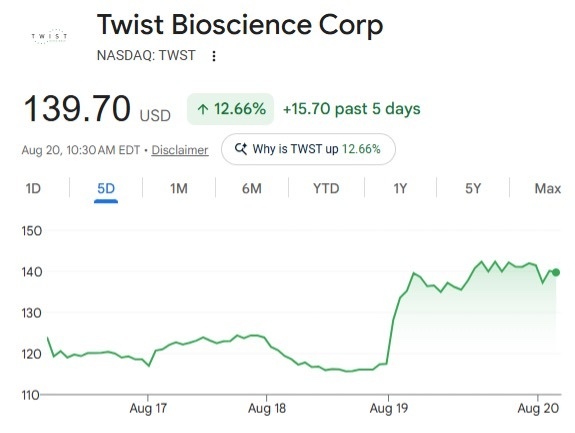 |
Researchers used Claude to design proteins aimed at 15 different biological targets, and Twist was one of the independent labs brought in to produce and test them. Claude-designed proteins successfully bound to 14 of the 15 targets.
93% bind rate? Pretty impressive for a computer.
We’re still a long way from turning one of those proteins into a drug you can pick up at CVS, but that’s not really the point.
The first wave of AI healthcare was largely about what the technology might eventually accomplish. We’re increasingly getting examples of what it can actually do.
And that’s happening at the same time the stocks are starting to wake up again.
Healthcare could ultimately become one of AI’s biggest markets simply because of the incredible amount of data involved. Genetic information, medical images, pathology slides, electronic health records, clinical trials, and millions of research papers.
No doctor or scientist could possibly process all of it. AI can.
Tempus AI (TEM) is a great example. The company has built a massive library of clinical and molecular data that it uses to help physicians better understand diseases, select treatments, and match patients with clinical trials.
And this is becoming a real business. Tempus generated $382.5 million in second-quarter revenue, up 22% from a year ago. Oncology testing volume increased 31%, while its data licensing and modeling business grew 36%.
Twist and Tempus are attacking the opportunity from different directions, but they’re part of the same bigger trend.
So are Recursion Pharmaceuticals (RXRX), which combines AI with biological data and automated laboratories to search for new drugs, and Schrödinger (SDGR), which uses computational modeling and machine learning to predict how molecules will behave before researchers spend enormous amounts of money testing them in the lab.
We’ve seen several mini bull markets in AI-healthcare stocks over the years. Investors get excited about AI drug discovery, genomics, or personalized medicine. The stocks take off. Expectations get ahead of reality. Then they come crashing back down.
That’s pretty normal for an emerging investment trend.
But over the last few months, several of these stocks have started building new uptrends again. And this time, the underlying technology is further along.
That’s what has my attention.
Drug development remains incredibly slow and expensive. Bringing a new medicine to market can take more than a decade, cost billions of dollars, and most candidates still fail.
AI doesn’t need to magically eliminate that process to create enormous value. If it can help researchers find better candidates earlier and kill bad ones faster, that alone could dramatically change the economics.
And drug discovery is just one piece of the puzzle. AI is already moving into diagnostics, medical imaging, pathology, personalized medicine, clinical trials, robotic surgery, and everyday patient care.
I’ve always been attracted to investment opportunities where two major trends collide. AI and robotics is one. AI and energy is another.
But AI and healthcare could ultimately be bigger than either of them.
There will be failures along the way. Lots of them. Biology is difficult, clinical trials still take years, and simply adding “AI” to an investor presentation doesn’t suddenly make a biotech company worth owning.
But the technology is getting better. Real-world applications are growing. Revenue is following. And now the stocks are beginning to respond.
We’ve had a few false starts with this trend before. But if this latest move is the beginning of something bigger, I’d rather be paying attention now than after AI healthcare becomes the next hot investment theme on Wall Street.
